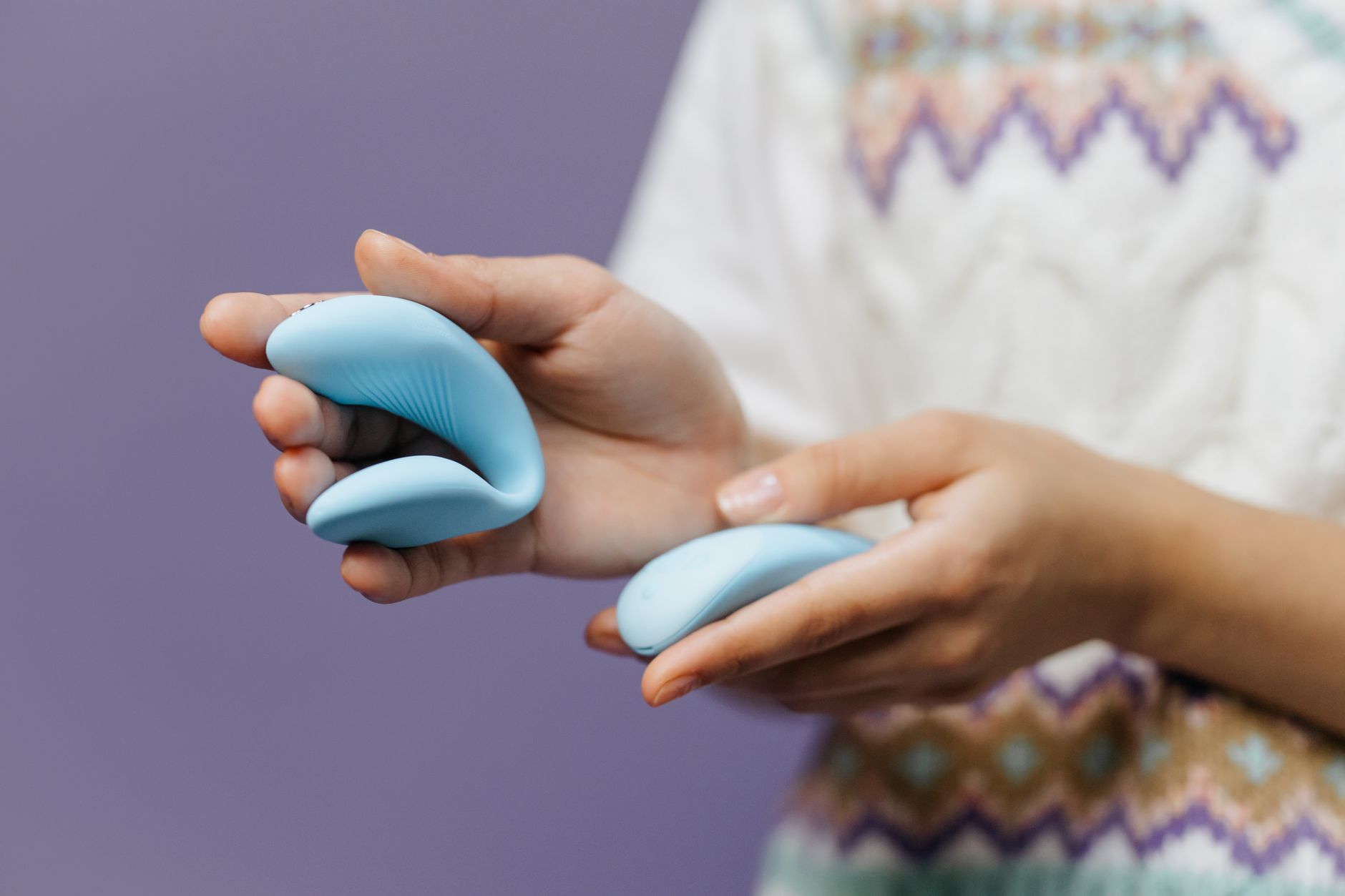
The sensitivity mismatch nobody talks about
You and your partner are ready to go. Then one of you is barely there, and the other is already overstimulated. The vibrator that feels perfect to them feels jarring to you. Sound familiar?
This isn't a compatibility problem. It's a biology problem. And lemon clitoral vibrators solve it in a way traditional vibrators never could.
Why partners have different sensitivity thresholds
Clitoral sensitivity isn't one thing. It's a mix of factors that shift independently.
Nerve density varies wildly from person to person. Some people are born with a higher concentration of nerve endings in the clitoral glans. Others have fewer, but those nerves fire more intensely. Neither is better or worse, they're just different starting points.
Hormones move the needle constantly. If your partner is in the luteal phase of their cycle, their threshold drops. Arousal itself changes sensitivity. A body that's deeply turned on can take pressure that would feel raw five minutes earlier. Medications, stress, how much sleep someone got last night, whether they ate breakfast. All of it reshapes the equation.
The problem with most vibrators is they apply pressure in a linear way. Higher speed equals more stimulation. If your partner needs intensity 8 and you need intensity 4, you're either compromising or you're not both satisfied. That's the trap that kills a lot of couples' exploration.
How suction technology bridges the sensitivity gap
A lemon vibrator works on suction, not friction. This is the key difference.
When the Lem engages, it creates a gentle seal around the clitoral glans and then draws blood to the area with rhythmic pulsing. The sensation isn't about pressure grinding against sensitive skin. It's about a pulling, surrounding stimulation that excites the nerve endings without direct friction.
Why does this matter for couples with different sensitivity levels? Because suction stimulates without the same mechanical harshness as a traditional vibrator. A person with high sensitivity can run the Lem on pattern 1 or 2 and feel intense pleasure without that "too much" rawness. Someone with lower sensitivity can push to patterns 5 and 6 and finally hit the level of stimulation their body needs.
You're not compromising on a medium setting that satisfies nobody. You're both accessing the right dose for your body.
The three ways lemon clitoral vibrators adapt better than traditional toys
Pattern flexibility trumps speed alone. Most vibrators give you speed 1 through 10. Lemon vibrators give you patterns. A pattern does more than change speed. The Lem's pulse patterns alter rhythm, pressure intensity, and acceleration. Pattern 1 might be a slow, deep pulse. Pattern 4 might be a rapid flutter. Pattern 7 might alternate between deep and shallow in a wave. Your partner might need the steady deep pulse. You might need the flutter. Same toy, two completely different experiences.
Suction doesn't fatigue sensitive tissue. Direct vibration on highly sensitive skin eventually leads to numbing. You've felt this. After five minutes of regular vibrator use, sensation starts to dull. Suction technology avoids this because it's not creating friction. You can sustain stimulation longer without the tissue saying "enough."
The seal creates intensity without speed. A lemon clitoral vibrator doesn't need to ramp up to painful speeds to deliver strong sensation. The seal itself intensifies the experience. Someone with low threshold can feel deeply satisfied at a lower overall vibration speed, while someone with high threshold can run higher patterns and actually feel them.
How to navigate sensitivity differences as a couple
Let's get practical. You've got a lemon vibrator. One of you finds it perfect immediately. The other isn't sure it's hitting right.
Start by mapping your patterns separately. Have each partner use it solo for a few sessions. You're not searching for the "right" pattern. You're learning what each pattern feels like on your body, at what intensity it starts to feel good, at what point it becomes too much. This removes the pressure of partnered exploration. You already know your territory.
When you use it together, check in without performing. "This feels better on pattern 3." "Okay, let's try pattern 3." Not a negotiation, not "let's find a compromise," just information. The person not receiving stimulation can handle the toy and control the pattern based on real-time feedback. This is actually hotter than you might think. It puts one partner in a more active role while the other focuses purely on sensation.
The role of verbal communication
Here's what I've seen work with couples. Before you use any toy together, agree on a simple scaling system. Not the clinical 1-10 pain scale, but something like "that feels early," "that's close," "that's it," "that's too much."
As you're using the toy, the receiving partner narrates where they are. Not constantly. Just when the pattern isn't landing or when they want to shift. "Let's try the next pattern." "Go back to the one before." "Stay here for a minute."
This sounds clinical written out. In practice, it's intimate. You're learning your partner's body in real time. You're also removing the guesswork that kills spontaneity. Half the tension in couples' exploration comes from the receiving partner performing pleasure they're not actually feeling, and the giving partner never knowing.
When sensitivity differences point to something bigger
Sometimes varying sensitivity isn't about biology. It's about how present someone is.
If your partner's sensitivity has dropped significantly, or if what used to feel good suddenly feels numb, check in about what's actually happening. Are they stressed? Is the relationship tension creeping in? Are they physically present but mentally elsewhere? A lemon clitoral vibrator is amazing, but it can't make someone who's checked out feel connected.
On the flip side, if one partner has high sensitivity and the other has shut down sensation entirely, that mismatch sometimes reflects something worth exploring together. Maybe one of you is afraid of vulnerability. Maybe one partner is using pleasure to avoid something else. How to Use a Lemon Vibrator When Pleasure Feels Disconnected After Trauma offers a deeper look at why sensation flattens and how to rebuild it.
The permission piece
Honestly, the biggest barrier to couples exploring lemon vibrators isn't the toy. It's permission. One partner worries that wanting a tool means there's something wrong with the other person. The other partner worries that suggesting a toy means they're not satisfied.
Neither is true. Sensitivity differences are neutral facts. A lemon clitoral vibrator is a tool that honors both bodies instead of asking one to shrink and the other to stretch. You're not fixing anyone. You're meeting each other where you actually are.
People also ask
Why do lemon clitoral vibrators work better than traditional vibrators for couples with different sensitivity?
Lemon vibrators use suction technology rather than direct vibration. This means a partner with high sensitivity doesn't experience the raw friction that can feel overwhelming, while a partner with lower sensitivity can access more intense stimulation through higher patterns without needing painful speeds. The same toy creates appropriate intensity for both bodies simultaneously.
Can partners use a lemon vibrator together at the same time?
Yes, though the design works best with one person receiving stimulation while the other controls the toy. The giving partner can be actively engaged by managing patterns and pace based on their partner's real-time feedback. Many couples find this deepens connection because it requires presence and communication.
What if one partner's sensitivity changes during sex?
That's completely normal. Arousal shifts sensitivity. A partner who felt numb five minutes ago might suddenly be very responsive as arousal builds. This is why having multiple patterns matters. You can adjust mid-session without stopping or losing momentum. Check in lightly. Let sensation guide you.
How do I talk to my partner about sensitivity differences without it feeling like criticism?
Frame it as discovery, not problem-solving. "I want to find what actually feels good for both of us" is different from "something's wrong with how you respond." Use a lemon vibrator as a joint exploration tool rather than a fix. The patterns and flexibility make it easier to find what works without anyone feeling inadequate.
Is it normal for lemon vibrators to feel less intense than other toys?
Not less intense. Different intense. Suction feels more surrounding, less pointed. If your partner is used to direct vibration, the first few sessions might feel "softer" even if you're on a higher pattern. Give it three to five uses. The sensation becomes clearer once your body understands what suction does versus friction.
What if one partner wants to use a lemon vibrator and the other isn't interested?
That's a conversation separate from the toy itself. You're not trying to convince anyone that lemon vibrators are objectively better. You're asking whether your partner is willing to explore something together. If they're genuinely not interested, that's okay. If they're hesitant out of shame or fear, that's worth exploring. How to Use a Lemon Vibrator When Your Partner Avoids Talking About Sex goes deeper into that dynamic.
The real shift
Most couples stay stuck on sensitivity differences because they treat them as problems to solve. One person needs more, one person needs less, and neither feels truly satisfied. A lemon clitoral vibrator reframes it. Different sensitivity isn't a mismatch. It's information. And when you have a tool that adapts to multiple bodies instead of asking bodies to adapt to the tool, suddenly both of you can feel genuinely good at the same time.
That changes things. Not because the vibrator is magic, but because you stopped asking one person to be smaller and the other to be bigger. You met each other exactly where you are.